
Our point of view
The Executive Age
Organizations are cutting the Middle in the name of AI. In doing so they are dismantling the only place executives grow… and they will need those executives sooner than they think.
The Shape We Inherited
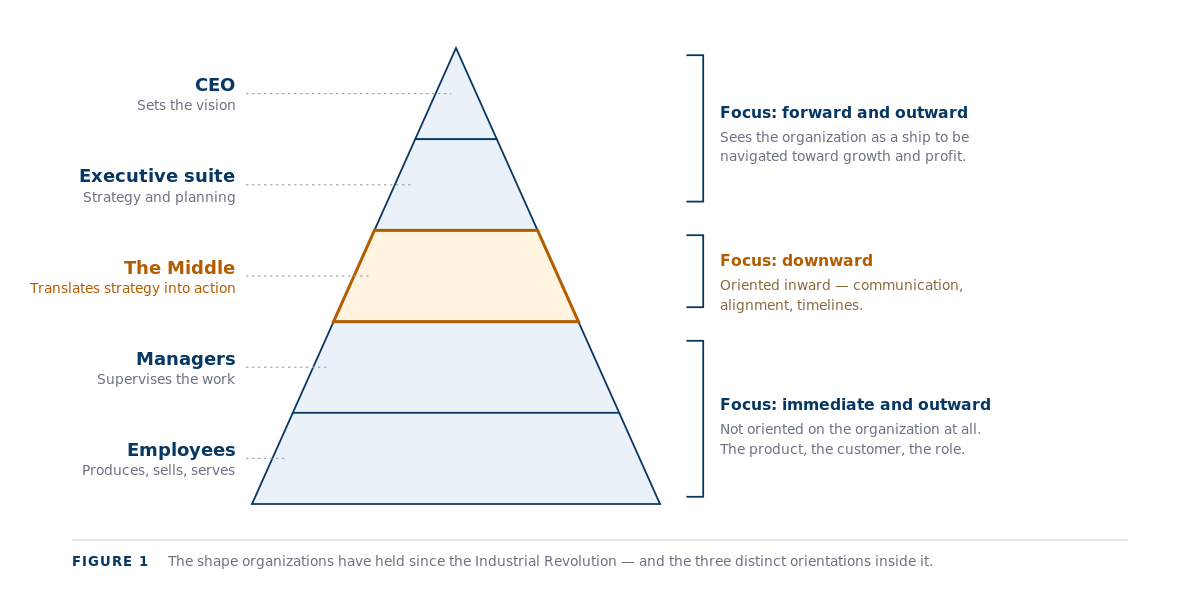
Organizations have held broadly the same shape since the Industrial Revolution. There are hundreds of variations, but behind them sits the same triangle with the same functional divides.
01
At the top is the vision layer: The CEO, founder, or owner. The most accountable role in the organization, responsible for setting the vision and seeing it through.
02
Below that, the strategic layer. The executive suite and senior VPs, accountable both for the performance of the whole organization and for their own function.
03
Then the Middle. VPs, directors and senior managers who straddle strategy and operations. They take the strategy apart, communicate it downward, and hold operational responsibility inside their area.
04
Then the operational layer. Managers who supervise the work, and the people producing, marketing, selling, delivering and serving.
The structure is familiar. What might not be is the direction of attention inside it.
At the top, focus is forward and outward. Leaders there see the organization as a ship being navigated through difficulty toward growth.
In the Middle, focus is downward and thought is oriented inward. They are immersed in communication, alignment, timelines.
At the operational level, focus is immediate and outward. Attention is not on the organization at all. It is on the product, the customer, and the person’s own role.
Three layers, three different directions of attention. This is a fact that companies are missing when deciding that the Middle is an extra layer they can simply cut.
The Case for Cutting it
As organizations look to AI for performance and cost, more and more of them have pointed to it as the reason they could reduce headcount. Amazon announced roughly 16,000 corporate cuts in January 2026 following 14,000 in October 2025, with Andy Jassy arguing AI would let the company reduce bureaucracy and operate with fewer management layers. Salesforce reduced customer support from about 9,000 people to roughly 5,000 after deploying AI agents. Citigroup has targeted around 20,000 eliminations by the end of 2026, with its outgoing CFO tying headcount decline to AI tools. HP expects to cut 4,000 to 6,000 roles by fiscal 2028 under an AI adoption initiative. Through June 2026, the technology sector alone had announced 139,156 layoffs. That’s up 83% year on year, according to TechCrunch’s tracking of 2026 layoffs
Some of this is inevitable, and some of it will prove to be a net positive we cannot yet see. In the way that machinery replacing factory labor eventually produced more factory work than it destroyed
But there is one area where I think businesses are getting it badly wrong.
They are cutting the Middle.
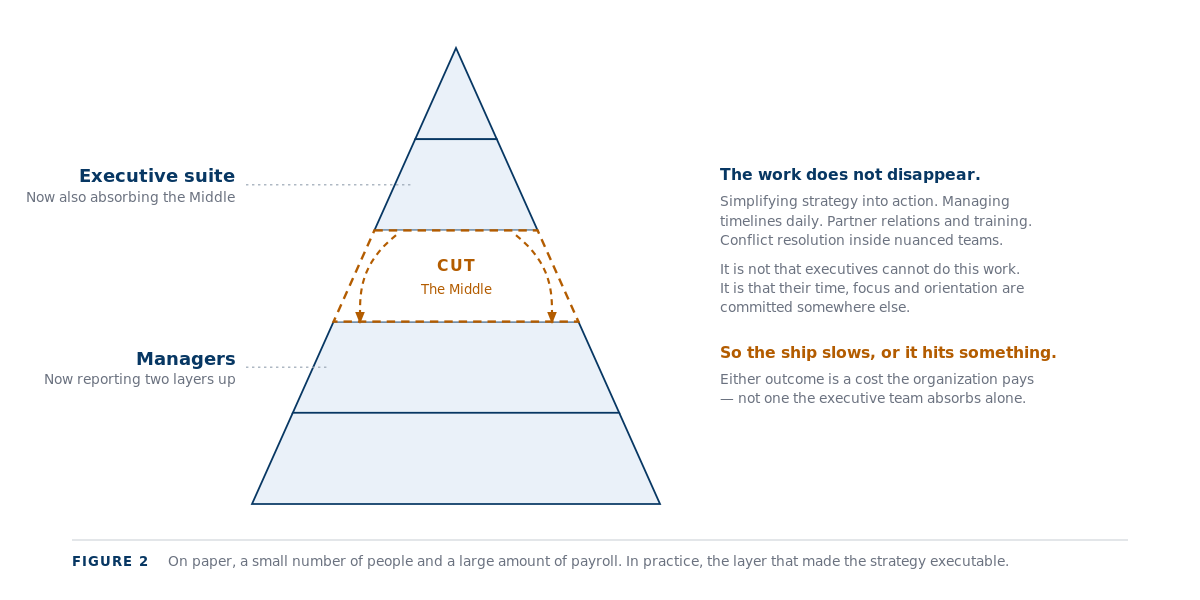
The argument for it feels logical and reasonable. The Middle is a small number of people carrying a large amount of payroll, so you can remove significant cost without affecting many people. This is better for morale and easier to communicate. And the executives already hold the plans, budgets and goals. Why not have them speak directly to the managers at the top of the operational layer – right?
Through that lens, cutting the Middle is not just defensible. It starts to feel obvious. You begin to wonder why you ever paid to maintain the layer at all.
Why it Collapses
1 — The job is not what it looks like on paper
The role of a Middle Manager is more time-intensive and requires more capability than an org chart suggests. Simplifying large concepts into actionable steps. Managing daily timelines rather than quarterly reporting cadences. Carrying operational responsibilities like partner relations and training. Managing people and resolving conflict inside team dynamics with nuances that take months to understand.
It is not that executives are incapable of this work. It is that their time, focus and orientation are committed elsewhere.
2 — The extra load is not ultimately absorbed by executives. It is paid by the organization
On paper this looks like a few more hours for people in the executive suite. In practice, I have never met an executive team with spare capacity – have you? Executive teams are not busy with tasks; they are overloaded with strategic priorities they cannot get to.
So when an executive has to keep turning around to follow up on a timeline, or re-engage a vendor, or settle a dispute between two teams on how to approach a problem, they are not moving the ship forward. The ship slows, or it hits something. Both are costs the organization pays.
These two reasons alone have been enough to make some organizations reverse course. Nearly a third of hiring managers who eliminated roles during AI-driven layoffs have since had to rehire humans into those same positions, according to HR Digest. And mid-level managers are among the highest rehire rates, alongside customer success and quality assurance. These are connective-tissue roles: they require emotional intelligence, cross-departmental negotiation, and an intuitive read on what a client really needs, not just what they said they need.
3 — A missing step in the making of an executive
Something important happens when a person takes the step from the operational layer into the Middle.
Their focus shifts from what is happening now to what is coming. The orientation of their thinking turns inward, toward the organization, instead of outward at the immediate task. They arrive in the role carrying a fresh, accurate picture of the front line and a working instinct for how direction will land with the people who have to execute it.
And they begin to learn the skills that leading at the executive level requires: systems thinking, risk assessment, managing up, decision-making, change management, financial acumen, opportunity spotting.
When an organization cuts the Middle, it damages its ability to grow a bench of future leaders. Eliminating middle managers in 2026 dismantles the apparatus that produces senior leaders in 2028 and beyond.
The evidence is already visible. DDI’s 2025 Global Leadership Forecast, drawn from more than 10,000 leaders across 50+ countries, found trust in immediate managers down to 29%, a 37% decline from 2022, with leadership bench strength sitting at 20%.
4 — The Executive Age
There is not yet a settled name for what the economy looks like after AI is broadly adopted. I think it will change so drastically that the shape of work will appear visibly different. I believe that the new shape will be structured in a way that will make organizations more dependent on executives, not less. So I am calling it the Executive Age.
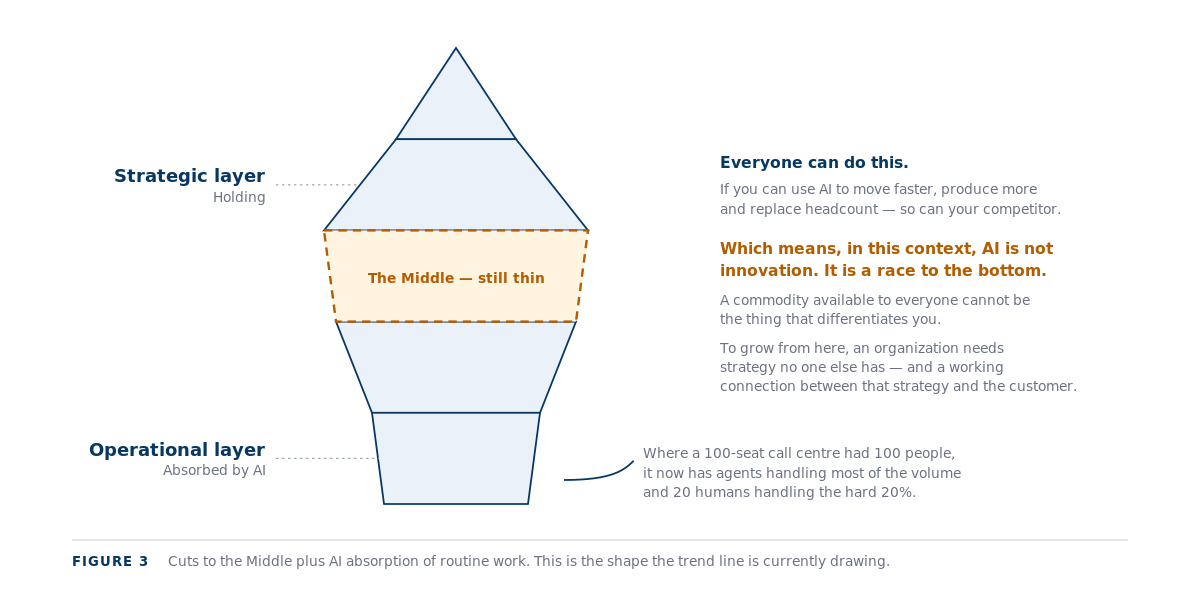
The shape changes for two reasons at once. Organizations are cutting the Middle. And AI really is replacing human work in the operational layer… where a 100-seat call center once needed 100 people, it now runs on AI agents handling most of the volume with twenty humans handling the difficult 20%.
Follow the trend line and most organizations end up looking like this. Which is where the problems begin.
If every organization can do this, most will
If you can use AI to move faster, produce more and replace headcount, so can your competitor.
At some point AI is not innovation. It is a race to the bottom.
It is a commodity everyone can implement at scale.
For that, organizations will need more executives: people with strong decision-making skills, the ability to recognize patterns to spot risk and opportunity early, and the ability to convert that into strategy that produces revenue and other desired outcomes.
And to support those executives, they will need more people in the Middle. People who understand how to execute a plan, how to employ AI, how to manage mixed teams of humans and agents, and how to direct that work toward a customer experience that is genuinely better. Not an experience that is merely faster, cheaper, or always available. An experience that is better.
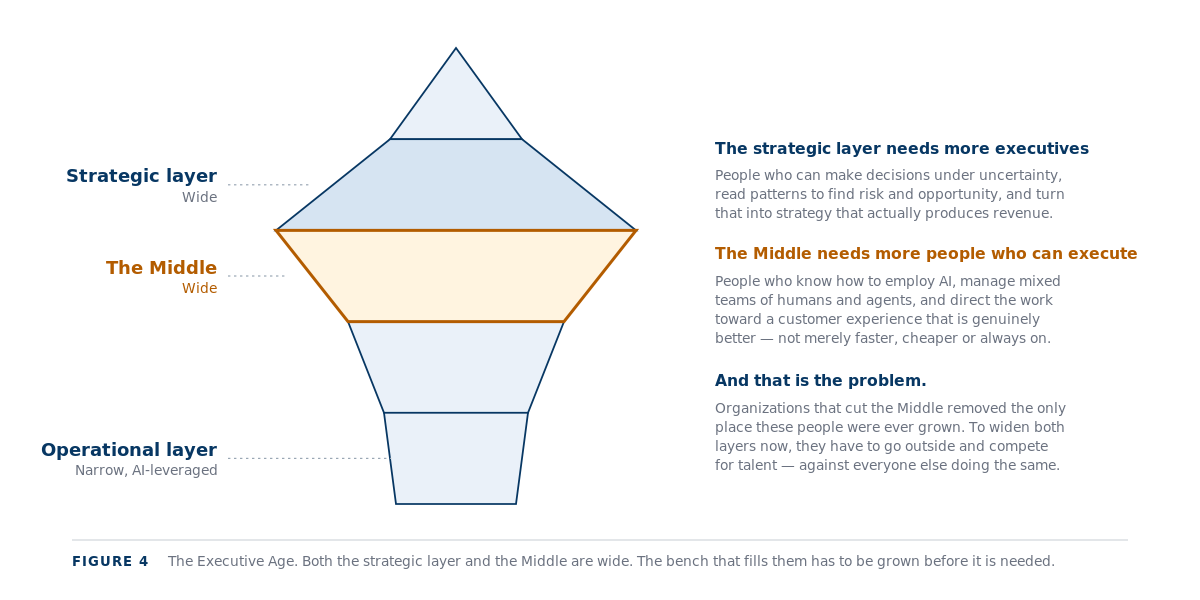
The organizations that thrive will hold a different shape: a wide strategic layer and a wide Middle, rather than the deep functional columns of the last several decades.
Instead of a triangle, the shape will look more like this: a fat diamond.
The Hitch in The Rebuilding Plan
For the quarters and years before that realization arrives, these organizations will have removed their pipeline of future executives… along with almost every other organization in their market.
To grow, or in some cases to survive, they will have to widen the strategic layer and the Middle again. And they will have to go outside to do it.
Why not hire from within?
They won’t have the talent inhouse:
First
there is no bench of emerging leaders learning the organization’s decision frameworks, working cross-functionally, or discovering how to drive change from inside. They cut the Middle.
Second
The operational layer cannot simply step up. They lack the skills required to lead at this level and the time to build them. And the shift in focus and orientation required to move from their current role to an executive function is drastic… too drastic. Today, they are responsible for their own performance, thinking about what is immediately in front of them. Asking them to stop and instead think about the company and the competitive landscape and to make decisions about what’s best for the organization’s future is too much.
So companies will have to compete for talent. And this is where it gets expensive for everyone.
Competition drives salaries up as organizations fight for the same shortlist. Training and ramp-up will slow growth. Even excellent hires need time to learn new systems, cultures and missions. There are simply not enough skilled people, because we capped the growth of the Middle for decades and then cut it. The pipeline will take years to refill.
And while it plays out, nobody knows who the winners are. Good people will join organizations that fail. Strong organizations will hire the wrong people because they moved too fast. For most organizations, it is going to be painful before it gets better.
How to Avoid The Pain
There is a way through this. It is simple. It is not easy.
Invest in the Middle now. Keep the pipeline flowing.
You do not need to know exactly which roles you will be filling as you reorganize around AI. You can upskill the bench you already have, and equip them with the competencies they will use to meet whatever arrives while your competitors are still recruiting.
Decision-making
Risk assessment
Change management
Having hard conversations
Cross-functional collaboration
Goal setting and achievement
When people develop those capabilities inside your organization, on your systems, in your culture, aimed at your mission, you enter the Executive Age with a bench that’s ready to seize the opportunities and the speed to do so while your competitors are playing catch-up.
That is the work we do.